Predestined to Drink? The Genetics Debate | Born Alcoholic or Choices Made You One?
- Jun 18
- 10 min read

One of my greatest contentions with the Alcoholics Anonymous philosophy would be the concept that alcoholics have a disease. That the reason they are alcoholics today wasn’t because they kept putting the bottle to their mouths but were unwilling victims who had no clue that their DNA contained the genetic code of a monster, who was lying in wait for that first taste of the barley. The opening of the gate that allowed the demon to rush into the fortress whose guards were unaware it was hidden outside of the castle at all.
And I can’t say I subscribe to this and the topic seems to be a matter of great contention among those who do professionally study the subject. One camp resides with the AA mantra that genetic makeup is responsible for the addiction. They contend the person was an alcoholic before he ever picked up the first drink. Hence, he is born with a disease, no different than someone who is a healthy twenty-year-old, and is completely unaware that the cancer gene is embedded, waiting to make its debut in a few decades.
I can understand this point of view. As a former practitioner in the medical field, I have had thousands of patient history reviews, which include past familial history. People who suffer from depression usually had a parent with the same affliction. I imagine generationally there were certain genetic code sequences that would have served as future predictors for these symptoms. And I imagine, whether looking at depression or alcoholism, it would take only a few generations of the affliction before that coding became imbedded for a future descendent of that family tree.
The other camp of thought, when talking about the origin of alcoholism, states that the addiction is more socially learned. There is a great deal of rationale in this worldview as well. I once visited the house, in which I grew up, located in a small river town in rural Indiana. The owner actually knew my father quite well although he had not been in contact with our family for decades. He stated I reminded him of my dad, not in appearance but in mannerisms. Facial expressions, movements and the like. This does make sense as we are all very trainable creatures and that training largely comes from our parents.
Could it be possible that alcoholism was modeled into us? For most of us former or current alcoholics had one or two parents who were the same. Just like the person whose parents suffered from depression was indoctrinated into that mental mindset. According to the owner of my former house, I had the mannerisms that matched my father’s. Does the depressive learn his mental state from which he was brought up? And does that follow for the future alcoholic as well?

Alcoholics Anonymous will insist that their contention of alcoholism being a disease is the correct truth. And of course this programs its members to believe they never had a choice in their alcoholism, that their code was programmed long before they were even born. But the fact is that it is difficult to know for sure. Many of the young drink excessively during their youth. But most do not become alcoholics. Some become alcoholics even if they had no lineage of the addiction. It would be relatively easier to take a group of known alcoholics and trace the common culprit of why they developed the addiction. But to take all the populace of those who consumed heavily in earlier days and decipher who had what background and who developed addiction and who didn’t would be a much more arduous task.
For instance, one could look at the soldier population. There are two types of soldiers. Those who did one enlistment, known as a “tour,” and those who made the military a career. I was a one tour soldier. My only social associations were other soldiers in my unit, which is common in the military. There wasn’t anyone I knew who didn’t drink excessively and usually daily during this time. A different persona but similar scenario is the college student, living in the dorms. Drinking is rampant in college. But drinking can be rampant, especially with males, outside of college in the era of one’s early twenties as well. There is a certain wildness of youth, which usually by axiom includes large amounts of alcohol. And this “alcohol abuse” will last for a few years. A few years is plenty of time to become addicted to a substance, just like smoking. If one smokes for a few years, usually the nicotine demon has got you.
But then there is the inquiry. A great many who smoke for a few years end up smoking well into their lives if not for their entire lives. In contrast to the great many who abuse alcohol for a few years in their reckless youth, whether military or otherwise, but yet return to social drinking as they age. What causes, in a drinking populace of a few years, one group to become addicted and the other to return to only social drinking? The first knee jerk answer would be it obviously is a genetic trap waiting to close on the future alcoholic, who doesn’t realize he just stepped into it with that first bottle to his lips.
However, there are other factors with these genetically inclined future alcoholics. Most had traumatic childhoods. Many times those traumas are associated with the home. For if one or both parents are alcoholics, how swell do you think the home life was for these people? It isn’t a matter of simply “learning how to be an alcoholic” from your mother or father. Alcoholics tend to be dysfunctional and many times that dysfunctionality includes meanness and abuse toward the children. Adult life is affected by childhood trauma, whether one drinks or not. Many survivors of childhood trauma have self-esteem problems, lack of confidence, problems in relationship building and depression as a result of their past.
I can attest to this. As I had a horrible high school and home life. The first time I really hit John Barleycorn hard was at a high school graduation party. I had switched high schools at my junior year and due to an intense fear of social situations by the time I reached the second school, had been a recluse, existing in isolation my entire remaining time there. But I went to the party, which I handled this angst by drinking a great deal of vodka and beer, which one can imagine did not turn out well. But it did eliminate the anxiety for a time. In one of my writing works, I describe the effect of my new compadre, John Barleycorn, as not only pushing away the anxiety but giving me the sensation of feeling pretty fine at the event. Unfortunately, soon afterward I wasn’t nearly as fine while retching on the lawn followed by a severe hangover sickness that lasted for two days.

I swore on a few generations’ graves that I would never touch it again. And I didn’t for about two weeks until at a get-together with finally some new friends. This time I consumed beer only but in enough quantity where, yes, I was hungover the next day but not nearly with the extreme symptoms as the first time. But the social anxiety reduction effect was the same.
Most adults who experienced childhood dysfunctional surroundings do not understand that they remain to be affected in adulthood. It took myself until forty, the age when I ended the tie with John Barleycorn, until I finally put the pieces together. I realized that emotionally, the fifteen-year-old was frozen in time. I read a great many books on the subject. It became very clear why the friendship with J.B. had developed in the first place. It was a numbing agent in my early twenties. And if you sip on that agent long enough, eventually physical addiction will become the next phase of the substance abuse.
This is probably the largest difference between those who indulge for a few years recklessly and those who develop addiction to alcohol. Neither group usually starts out drinking every single night unless you are on that intense military team. For most of youth, it is usually weekends where the greatest consumption occurs. But somewhere in the mid to later twenties, the two groups diverge. The young, reckless drinkers begin to taper their intake down after the military, college or just the closing of their early youth. They have careers they are focusing on, may be married and with children by now. And they simply don’t have the energy they did at nineteen. That fuel continues to lessen with age. So this group transforms into that social, just a few drinks at outings participants, with only the occasional drunk on New Year’s Eve.
The alcoholic group evolves into the exact opposite. The intake only begins to increase with age, energy level or not. The few nights a week with heavy consumption gradually becomes every night. But is this just the “alcoholic gene” finally kicking in? I’m pretty sure I could have quit alcohol completely after I left the military. As a matter of fact, I greatly cut down by my first year of college. But I was also contending with the past of childhood trauma. Even as a well-practiced martial artist and bodybuilder, I didn’t have the mental confidence I thought. Somewhere, underneath the guise of round kicks and bench pressing, I subconsciously and many times consciously knew that. And alcohol was the anesthetic that kept those thoughts buried at the bottom of the canyon.
It may take longer to become addicted to alcohol than cocaine or even smoking. In the early days of the youthful excessive drinking, one has time to get out and escape its grasp. I contend that it wasn’t a physical craving by my later twenties that led to alcohol addiction but an emotional one. But if you continue to use the substance to ease these emotional ills, eventually the physical addiction will finally take you. Once that happens, you are in the clutches of John Barleycorn. And the rest will be history as the intake will only increase as will the withdrawal symptoms if you quit.
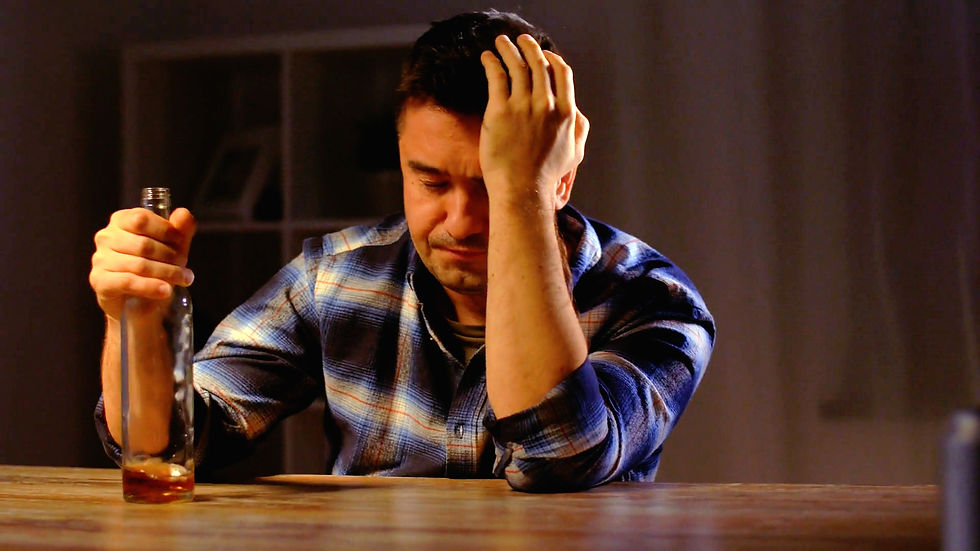
As said, there is great debate whether genetics or social environment will lead one down the road to alcohol addiction. Many believe it is a combination of both, which makes the most sense. One is born with a genetic predisposition to the addiction, alcoholic behavior is socially learned in a traumatic childhood where later the toxic substance is also the reliever of pain. The childhood is never dealt with so that reliever of pain is the only avenue of emotional escape. Then enough time passes until the body becomes physically addicted to the substance. An alcoholic is born.
But here is my great contention with Alcoholics Anonymous. It doesn’t matter the reason why one became addicted. And alcoholism isn’t a disease. These statements, especially the second one, will cause AA to snarl. For it is heresy to their entire platform of premise.
First, alcoholism isn’t a disease. It is an addiction. I will concede that there may be genetic factors that give predisposition to the addiction. The “alcoholic gene” I have read about. But the greatest factor that exists is the one of choice. The person born with the cancer gene doesn’t have it. He can’t just decide to quit cancer. The alcoholic can quit his addiction. The AA community would like to act like one was a total victim, unaware that he was an addict. There is no one who drinks a twelve pack or pint of gin every night and thinks this is normal. One may hide this fact for social repercussion reasons, but everyone who drinks this much every night knows this is not on par. Unlike cancer, the cure is always there and unlike chemotherapy, that method for cure will work one hundred percent of the time. All you have to do is quit.
And the why doesn’t matter. It doesn’t matter if it was social, genetics or both put together. Everyone has that choice whether they are going to become addicted to alcohol or not. If one has alcoholic parents, then it would be wise to just avoid the substance all together. But if one sees himself consuming more and more in his twenties or using the substance to detour internal angst, then that is the time to veer off the road in which John Barleycorn travels. The idea that I couldn’t help it, it was in my genes is nonsense. No one is oblivious when he is doing something harmful to himself. That “De-Nile” river in Egypt is a dry bed. It’s a big excuse to take the blame off oneself that the addiction resulted in something other than a bad choice in life. I say that as someone who had alcoholism rampant in his family, had a terrible social environment at home and school in my formative years, became addicted to alcohol, was a raging alcoholic for thirteen years and quit it and proclaimed cure two years later. I probably have the “alcoholic gene.” It was all still my own doing and poor choice those many years ago.
The philosophy of the alcoholic is born with a disease via this offshoot gene is destructive. AA claims that they promote taking responsibility yet this gives a mental way of not doing so. It is also destructive for the person will see himself as forever diseased, which is terrible for self-esteem recovery. We all did enough stupid, nonsensical, depraved things while under the tutelage of John Barleycorn, which we would all like to have removed from our memory. We don’t need to add “diseased” to our list of personal attributes, especially when one has left that life in the past.
But whether genetics is a partial factor or not, the fact remains that if you are reading this, you have probably ceased the friendship with John Barleycorn. Focusing on the why isn’t relevant after a few months clean. Your future sobriety doesn’t depend on some DNA sequence and you are not destined as a forever deficit person. Your master status is not alcoholic. Your future self is the best possible version of yourself which you accomplish by reinventing the physical, emotional, career and spiritual planes of your being. And an “alcoholic gene” doesn’t impede you from advancing these planes.
Nor should it be thought about once you make the correct choice of leaving the alcoholic addiction behind.
To journey on a tale of epic transformation on a 2,660 mile trail check out: THE SHEPHERD AND THE RUNNINGWOLF: A PATH TO FORGIVENESS ON THE PACIFIC CREST TRAIL
(Usually free on KDP)
To recreate your life on all planes for the best version of yourself as possible:REINVENTION OF SELF: HOW TO CHANGE YOUR LIFE AND BEING FOREVER
(Usually free on KDP)
For the condensed and orderly version of how I beat the addiction of alcoholism check out: THE SMALL BOOK: HOW I BEAT ALCOHOLISM AND WHY ALCOHOLICS ANONYMOUS DOESN'T WORK
(Usually free on KDP)
John Barleycorn taken from Jack London's book, John Barleycorn. First published 1913


Comments